Effective QA Testing Using AI as an Assistant
January 28, 2026
|
3
minute read
Blog


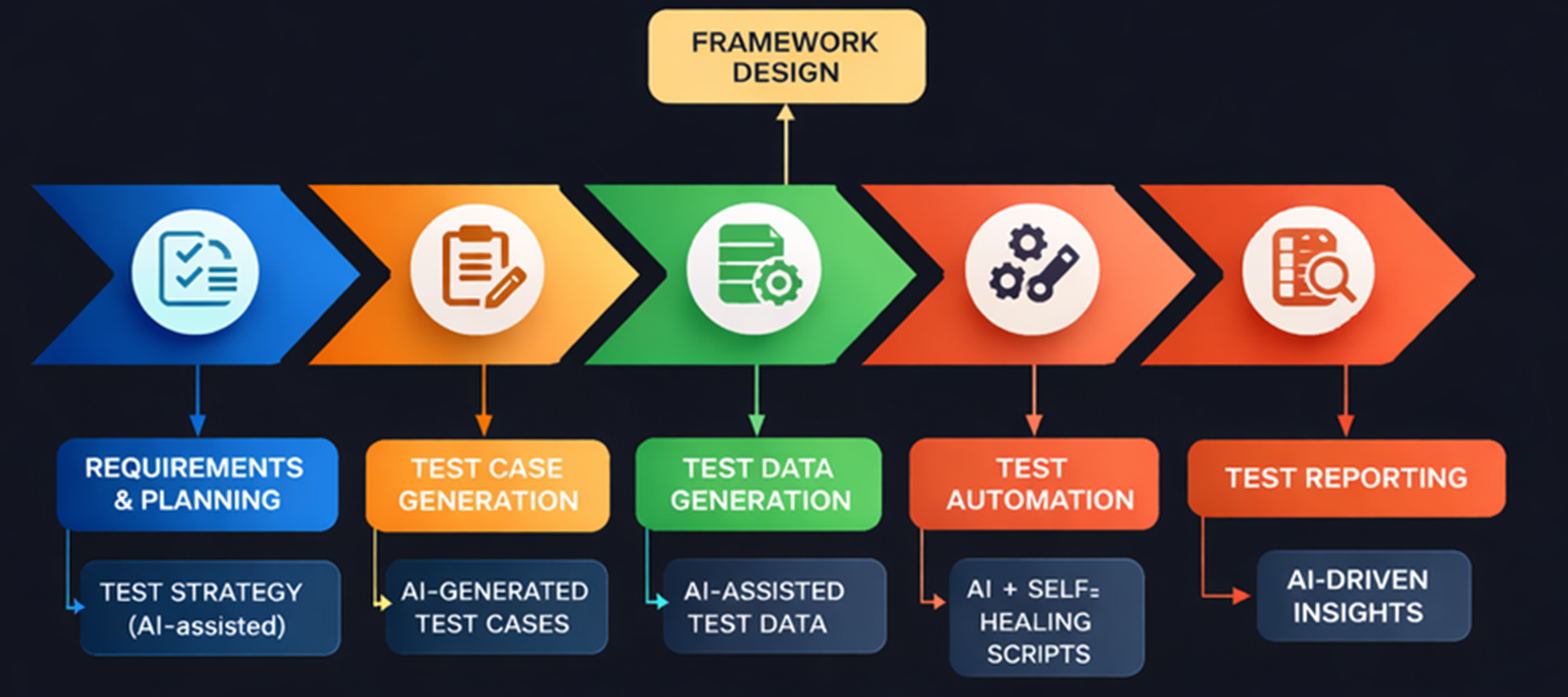
Leveraging Artificial Intelligence (AI) in the QA software testing lifecycle can significantly reduce the manual effort spent on repetitive and time-consuming tasks. While AI cannot replace traditional software testing, it can act as a powerful assistant that helps accelerate testing activities and allows QA teams to focus on more critical and exploratory testing areas.
By integrating AI across different stages of the testing lifecycle, teams can improve efficiency, consistency, and overall delivery speed.
Test Strategy & Test Plan Creation:
AI can be used to generate an initial draft of test strategy and test plan documents by providing key inputs such as project scope, testing objectives, and required deliverables.
Once the draft is created, the QA Lead can review and enhance it by adding project-specific details, risks, timelines, and resource planning. This approach saves considerable effort compared to creating these documents from scratch.
Benefits:
Tools (Sample): Microsoft Copilot
Test Case Generation:
AI can assist in generating test cases directly from user stories or requirements (e.g., Jira stories). Instead of designing test cases manually from the ground up, QA teams can use AI to create an initial set of test cases and then review, refine, and prioritize them before execution.
This significantly reduces the effort required for test design while maintaining coverage and quality.
Benefits:
Tools (Sample): AI test case generator in Jira, Smart Fox AI in PractiTest and Browser Stack AI test generator.
Test Data Generation:
Test data plays a critical role in validating application behavior under different scenarios. AI can help generate multiple sets of test data based on an initial input, covering various combinations, edge cases, and boundary conditions.
This reduces the time and effort involved in manually preparing diverse test data sets for functional and regression testing.
Benefits:
Tools (Sample): Microsoft Copilot along with Faker Library.
Test Automation:
AI-powered automation tools can assist in creating regression test scripts with minimal or no coding effort. This enables team members without deep automation expertise to contribute to automation efforts.
Additionally, AI features such as self-healing scripts help maintain automation suites by automatically adapting to UI or application changes, reducing maintenance effort over time.
Benefits:
Tools (Sample): Playwright AI Agents, Applitools.
Test Reporting:
AI can also be used in test status reporting by generating an initial draft of test reports based on execution results. QA teams can then enhance these reports with insights, risks and recommendations before sharing them with stakeholders.
This ensures quicker and more consistent communication across teams.
Benefits:
Tools (Sample): Microsoft Copilot
AI cannot independently perform all QA activities without the expertise and judgment of QA professionals. However, when used as an assistant, AI can significantly reduce manual effort and improve productivity across the testing lifecycle.
Given the fast-paced release cycles and multiple testing responsibilities faced by QA teams, AI enables testers to focus more on critical thinking, exploratory testing, and quality assurance rather than repetitive tasks.
It is also essential to carefully evaluate security, data privacy, and compliance aspects before adopting AI tools within the testing lifecycle.
--
Fabric Group is a collective of passionate professionals focused on delivering meaningful value for our clients. We combine deep expertise in strategy, design, and software engineering with a distinctive design-thinking approach, underpinned by strong engineering capability, to solve complex business challenges and drive measurable outcomes.
Industry- and technology-agnostic by design, Fabric always works in the best interests of our clients and their goals, selecting the right tools and approaches to create lasting impact. As of 2026, our team of 130 specialists operates across Australia, India, the Philippines, China, and Singapore, bringing a global perspective with local insight to every engagement.
If you're looking for support in accelerating your digital journey, we would love to hear from you.



.svg)