Building Resilience: A Beginner's Guide to Chaos Engineering
September 4, 2026
|
minute read
Blog


Every system fails eventually — the only question is whether it fails at 3 PM while an engineer is watching, or at 3 AM while everyone is asleep. This article introduces chaos engineering, a practice of deliberately injecting small, controlled failures into a system to see how it behaves under stress. It explains why organisations are choosing to break their own systems on purpose, walks through the core ideas in plain language, and looks at the tools commonly used to do it safely.
This article is meant as a friendly, non-technical starting point. Readers who want to build production-ready chaos experiments should treat this as the "why" and "what," with the "how" to follow in deeper technical resources.
Overview: Chaos engineering is the practice of intentionally breaking things in a controlled way, then watching how the system reacts and using what's learned to make it stronger. It sounds counterintuitive — why would anyone want to cause an outage on purpose? — but the logic holds up. Organizations such as Netflix , Google, and LinkedIn are already doing this.
The Core Idea Most teams find out their system is fragile the hard way: a server crashes, a network hiccups, and suddenly customers can't check out or log in. Chaos engineering flips that around. Instead of waiting for a real incident to expose a weakness, teams simulate small versions of that failure themselves, in a safe and measured way, and fix what they find before it becomes a real problem.
Two things happen in every chaos experiment:
Controlled, Not Random The word "chaos" is a bit misleading — the practice is actually the opposite of chaotic. It follows a few simple ground rules:
Overview: It's easy to assume a system is resilient because nothing has gone wrong yet. Chaos engineering exists to test that assumption before a real customer does it for you.
Fewer 3 AM Wake-Up Calls The biggest sell is proactive versus reactive reliability: finding and fixing weaknesses before they turn into an incident that wakes someone up in the middle of the night. It's far cheaper — in money, stress, and reputation — to discover a flaw during a planned experiment on a Tuesday afternoon than during a live outage.
Exposing Hidden Dependencies Modern systems are built from dozens of smaller services that all depend on each other. Chaos engineering is good at exposing the weak links and brittle connections in that web — the quiet assumptions engineers make about "the network will always be fast" or "that service is always up" that only get tested when something breaks.
Real Confidence, Not Assumed Confidence Most systems have safety nets built in — retries, fallback options, auto-scaling, backup servers. But have those safety nets ever actually been tested? Chaos engineering replaces the hopeful sentence "we think this will recover" with the far more solid "we tested it, and here's exactly how it behaves."
Chaos engineering has its own vocabulary, but none of it is complicated once explained plainly. These are the four ideas that show up in almost every experiment.
Steady State Hypothesis Before breaking anything, a team needs to agree on what "normal" looks like. This is usually measured through things a user would actually notice — like whether requests succeed, how fast pages load, or how often errors occur.
Probes Probes are simply automated checks that keep an eye on the steady state — before, during, and after the fault is introduced — so the team can see the exact moment things start to go wrong (or don't).
Blast Radius This is how much damage the experiment is allowed to cause. Good practice is to start with the smallest possible blast radius — like affecting one server instead of ten — and only expand once confidence grows.
Rollback Every experiment needs an "undo" button. Rollback is the cleanup step that removes the fault and returns everything to a safe, normal state once the test is done.
Faults generally fall into two buckets — problems inside the application itself, and problems in the infrastructure underneath it.
Application-Level Faults
Infrastructure-Level Faults

Overview: The right chaos engineering tool depends on your platform. In our case, since we use Kubernetes and AWS, Chaos Toolkit, Chaos Mesh, and AWS FIS were particularly useful. Other platforms have their own options, such as Azure Chaos Studio.
Chaos Toolkit A declarative, plug-and-play tool that isn't tied to any one platform. It's especially good at orchestrating an experiment from start to finish — defining the hypothesis, running it, and generating a report — using simple JSON files.
Chaos Mesh Built specifically for Kubernetes (a popular system for managing containerised applications). It offers a wide range of fault types and comes with a dashboard, making it a strong choice for teams whose systems live inside a Kubernetes cluster.
AWS FIS A fully managed fault-injection service built by AWS, ideal for teams whose infrastructure runs mainly on AWS.
The "Glue" Strategy In practice, the strongest setup usually combines two tools rather than relying on just one: one tool acts as the orchestrator — planning, running, and reporting on the experiment — while another acts as the actuator, the one that actually performs the attack.
A common pairing looks like this:
This combination means teams get the best of both worlds: strong orchestration and native, platform-specific fault execution. It also fits neatly into a CI/CD pipeline where Chaos Toolkit can trigger an experiment automatically and gate a release based on whether the system passes it.
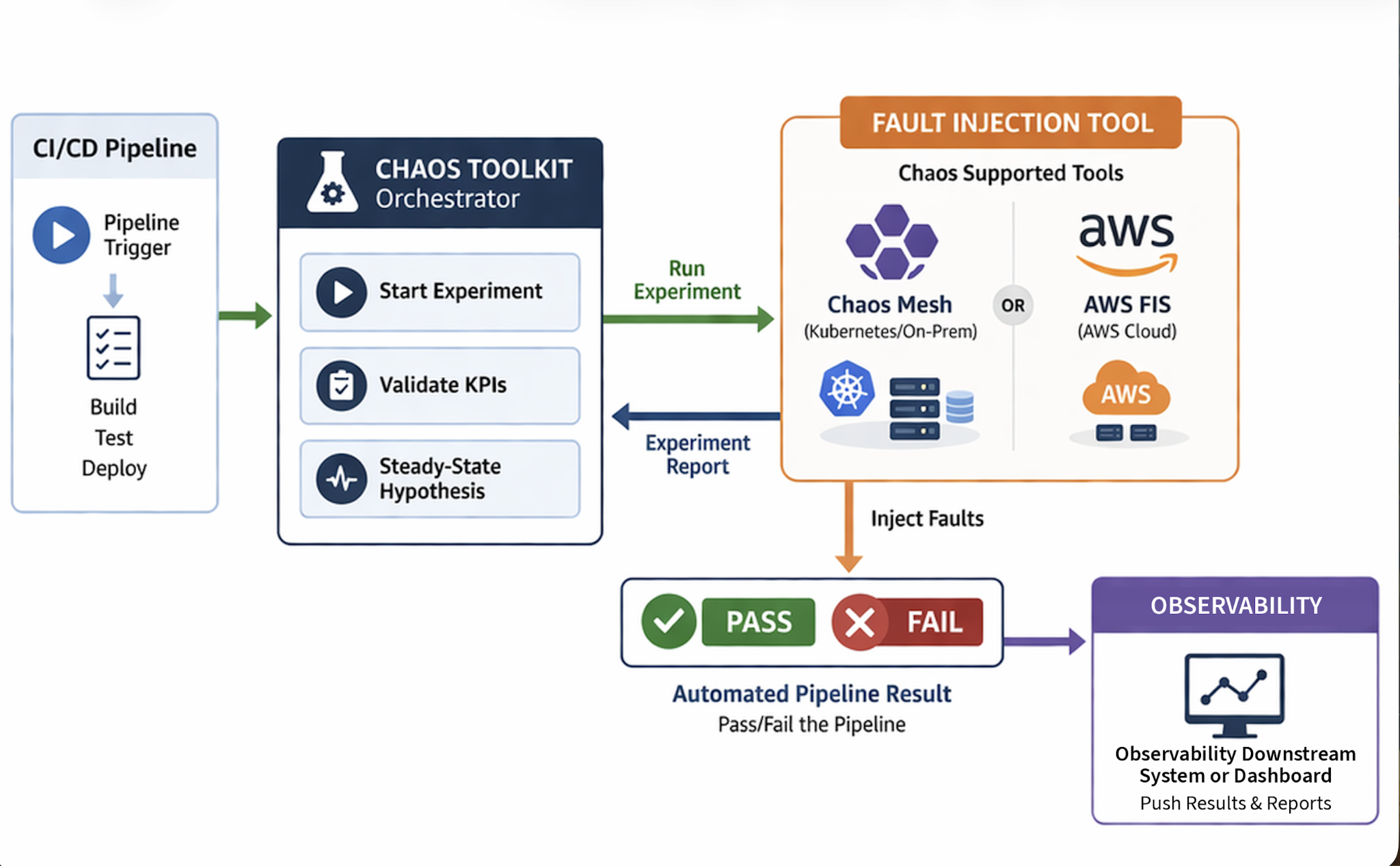
Every experiment, regardless of the tool used, follows the same five-step loop.
Consider an example: A single server is running behind an autoscaler, which is designed to automatically spin up a replacement if the server goes down.
This is the entire discipline in miniature — assume, test, observe, fix, repeat.
Overview: Adopting chaos engineering doesn't need to be a big-bang initiative. A gradual, low-risk rollout.
The payoff is real confidence in the mechanisms teams already rely on — autoscaling, retries, redundancy, recovery — tested and proven before they're needed in a genuine incident.
Chaos engineering is, at its heart, a simple and slightly rebellious idea: instead of hoping a system is resilient, prove it by breaking it on purpose — carefully, in small doses, with a clear plan to undo the damage. By defining a steady state, forming a hypothesis, injecting a controlled fault, and observing the outcome, teams turn hopeful guesses about reliability into tested, evidence-backed facts. Tools like Chaos Toolkit, Chaos Mesh, and AWS FIS make this practical at scale, and a gradual adoption path — starting small, attaching to delivery pipelines, and building maturity over time — makes it achievable for any team. The result is fewer 3 AM incidents, fewer surprises, and a lot more confidence in systems that were previously just "hoped" to work.



.svg)

.png)