Building an Effective and Scalable Automation Framework:
December 3, 2025
|
6
minute read
Blog
Written By
Vikraman VR
In modern software delivery, automation testing is a powerful lever for accelerating releases and improving product quality. But the real challenge isn’t running tests — it’s building an automation framework that remains reliable and scalable as the product evolves.
Low-code tools and AI-driven test creation can help teams move faster, but without strong fundamentals, they often produce brittle, high-maintenance test suites.
This article breaks down the core principles of designing an automation framework that delivers long-term value and keeps pace with shifting business and technology needs.
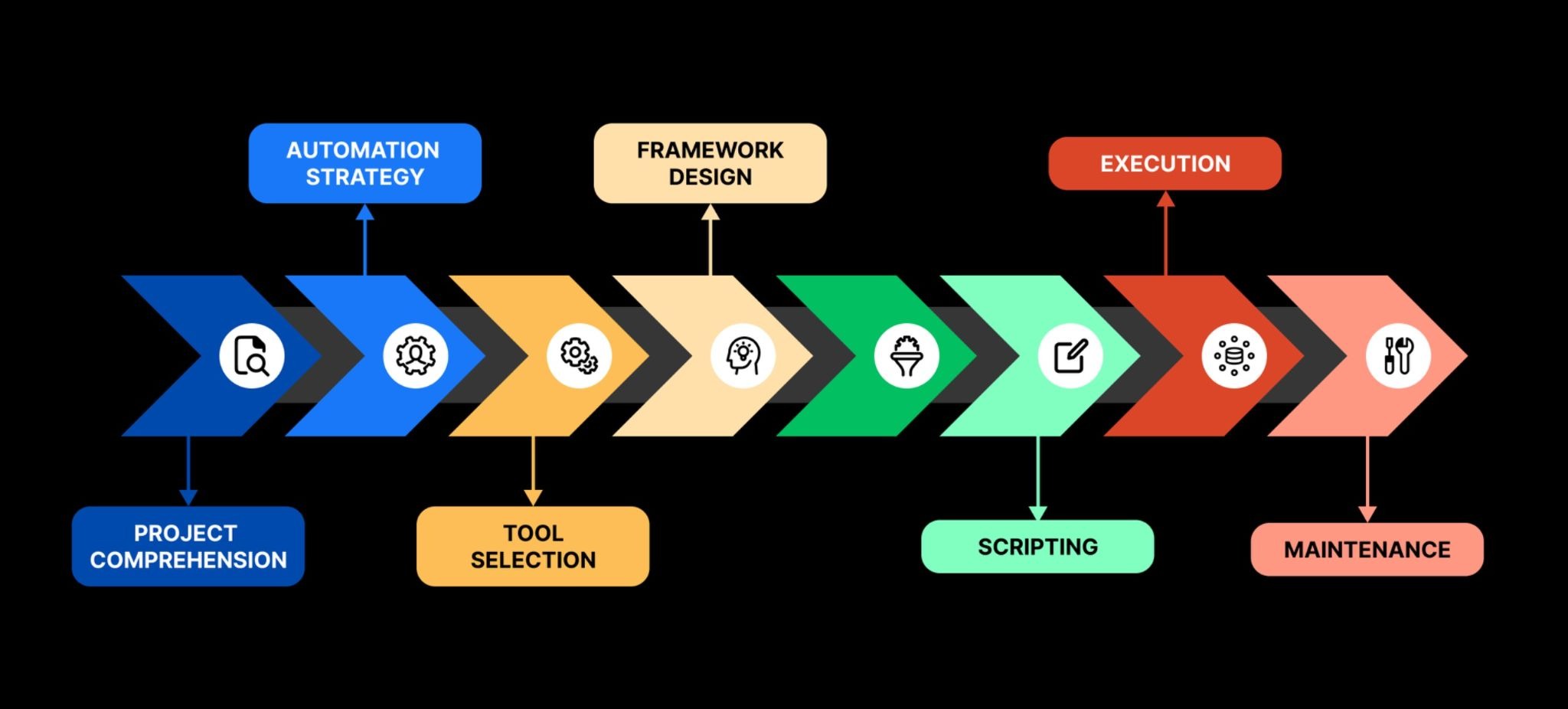
Understanding the Project:
A successful automation initiative starts with a deep understanding of the application and its testing needs.
Project Architecture: Begin with a clear understanding of the application’s architecture, its key components, modules, and data flows.
Test Environment Setup: Understand how test environments are configured, how test data is created, managed, and synchronized, and how these environments simulate real-world conditions across development, staging, and production.
Target Platform: Identify whether the automation focus is on web, mobile, API, or a combination thereof. Detail the specific devices, browsers, and operating systems where the automation must run to ensure comprehensive coverage.
Automation Scope: Identify the types of tests to automate, such as end-to-end (E2E), critical user journeys, or high-impact functionalities and decide on the areas that will deliver maximum value.
Success Metrics: Establish clear, measurable goals like maintaining at least 90% test coverage, accelerating release cycles through automated regression suites, and achieving a 100% pass rate with minimal flaky tests
Selecting the right Tools:
Once you have a clear understanding of the project requirements, automation scope, and success metrics, the next crucial step is to select the appropriate tools that will enable you to meet these objectives effectively
Automation Tool Assessment: Evaluate and choose an automation tool that aligns with your project’s technology stack, supported platforms, scripting languages, and team expertise.
Version Control: Choose a version control system to manage and maintain your test automation scripts and configuration files, ensuring collaboration, version tracking, and streamlined code management.
Test Case Management: Select a robust test case management tool that acts as a centralized repository for all test cases and seamlessly integrates with your automation framework, enabling comprehensive traceability and detailed reporting.
CI/CD Integration Tools: Choose tools that will enable smooth integration of your automation suite within your CI/CD pipelines, ensuring automated test execution on code commits and facilitating faster feedback cycles.
Design the Automation Framework:
When designing an automation framework, it is crucial to incorporate multiple design principles and components that work together to create a solution that is scalable, maintainable, and flexible enough to adapt to evolving testing requirements.
Multi-Environment Support:
Externalize configuration settings to ensure your framework can easily switch between different environments without code changes.
Support multiple environment profiles to manage environment-specific variables such as URLs, credentials, and test data sources, enabling seamless execution across development, staging, and production
Robust Test Data Setup:
Ensure the test data setup works seamlessly across different environments: development, staging, and production-like to maintain consistency and reliability of tests.
Implement flexible and reusable test data management strategies, including parameterization and data-driven testing, to maximize coverage without redundant test cases.
Page Object Model Pattern:
The Page Object Model separates test logic (“what” to test) from the details of page interactions (“how” to perform actions), improving clarity and organization.
UI elements and interactions are encapsulated within dedicated page classes, so if a page element changes, updates only need to be made in one location.
This separation reduces code duplication, making the automation framework easier to maintain and more resilient to UI changes.
API Service Object Model:
Create reusable service layers that encapsulate API endpoints, abstracting the details of request construction and response handling.
Centralize API request building to promote consistency and reuse, minimizing duplicated code across tests.
Implement response validation within the service layer to standardize assertions and error handling for API responses
Reusable Components:
Develop reusable functions and utility classes that encapsulate common actions such as saving session storage, logging, screenshots and waiting mechanisms.
Centralize these utilities to avoid code duplication across different test scripts and modules.
Promote consistency in automation scripts by using standardized helper functions for frequently performed tasks.
Robust Error Handling and Logging:
Implement comprehensive error handling to gracefully manage unexpected issues during test execution.
Log detailed error information, including timestamps, stack traces, and contextual data, to facilitate efficient debugging and root cause analysis.
Design retry and recovery mechanisms to handle transient failures and improve test stability.
Reporting:
Integrate advanced reporting tools that deliver clear and actionable insights into test execution results, helping teams quickly identify pass/fail statuses.
Provide detailed trend analysis and historical data to track quality improvements and detect recurring issues over time.
Include comprehensive failure diagnostics with logs, screenshots, and stack traces for efficient root cause analysis and debugging.
CI/CD Integration:
Design your framework to integrate seamlessly with CI/CD pipelines, supporting automated test execution triggered by every code commit and pull request.
Enable rapid feedback loops to development teams, allowing early detection and resolution of issues.
Automate testing across different stages of the pipeline (build, deployment, post-deployment) to maintain continuous quality.
Integration with TCM tools:
Link automated tests directly with test cases stored in TCM tools to establish clear traceability.
Configure your automation framework to trigger test runs within the TCM tool automatically when the automation suite executes.
Ensure that each automated test execution corresponds to a test run or cycle in the TCM system for clear synchronization.
Automatically update test run results in the TCM tool, including pass/fail status, execution time, error logs, and associated screenshots or attachments.
Alerts and Notifications:
Set up alerting systems that send immediate notifications about test results and failures to relevant stakeholders.
Use popular communication channels like email, Slack, or gchat to deliver these notifications for wide accessibility.
Automate the notification process as part of the test execution workflow for consistent and timely updates.
Maintenance and Enhancements:
Continuously evaluate and update the automation framework to integrate emerging tools, technologies, and industry best practices, ensuring it remains current and effective
Regularly refactor the codebase to enhance its structure, readability, and performance, which supports long-term maintainability and adaptability.”
A mature automation framework is far more than a collection of scripts — it is an engineering system. When strategy, tooling, design patterns, and CI/CD come together, automation becomes a durable asset rather than overhead. Teams gain faster releases, better product stability, and the confidence to ship continuously without compromising quality.
The payoff compounds over time: the more the product evolves, the more the framework proves its value. With the right foundations and a culture of ongoing maintenance, automation stops being a cost center and becomes a force multiplier for engineering velocity and long-term product reliability.





.svg)

.png)